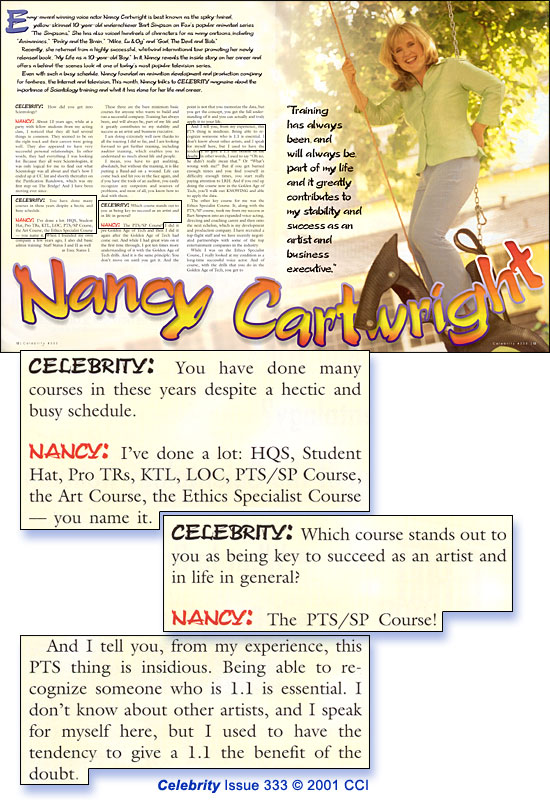
CELEBRITY: You have done many courses in these years despite a hectic and busy schedule.
NANCY: I’ve done a lot: HQS, Student Hat, Pro TRs, KTL, LOC, PTS/SP Course, the Art Course, the Ethics Specialist Course — you name it.1
CELEBRITY: Which course stands out to you as being key to succeed as an artist and in life in general?
NANCY: The PTS/SP Course!
And I tell you, from my experience, this PTS thing is insidious. Being able to recognize someone who is 1.12 is essential. I don’t know about other artists, and I speak for myself here, but I used to have the tendency to give a 1.1 the benefit of the doubt.
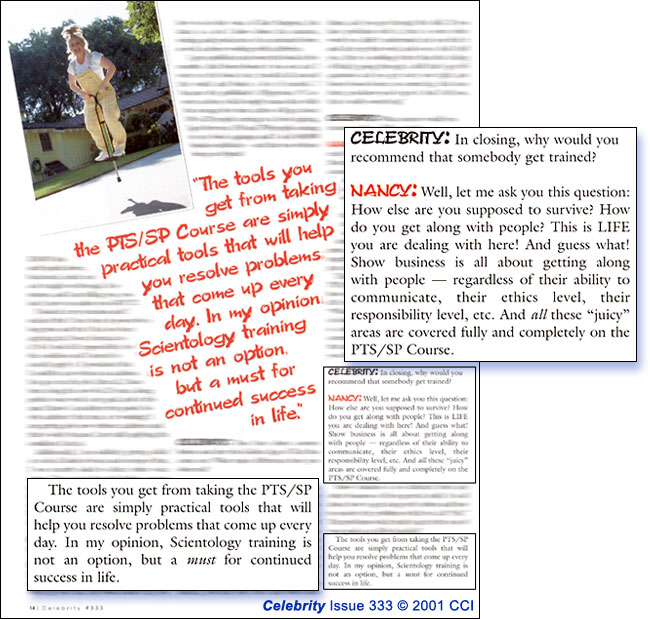
“The tools you get from taking the PTS/SP Course are simply practical tools that will help you resolve problems that come up every day. In my opinion Scientology training is not an option, but a must for continued success in life.”
The tools you get from taking the PTS/SP Course are simply practical tools that will help you resolve problems that come up every day. In my opinion, Scientology training is not an option, but a must for continued success in life.
CELEBRITY: In closing, why would you recommend that somebody get trained?
NANCY: Well, let me ask you this question: How else are you supposed to survive? How do you get along with people? This is LIFE you are dealing with here! And guess what! Show business is all about getting along with people — regardless of their ability to communicate, their ethics level, their responsibility level, etc. And all these “juicy” areas are covered fully and completely in the PTS/SP Course.
SPDL Note: Scientology’s “Tone Scale,”1 invented by cult founder L. Ron Hubbard, is a graduated scale of emotions each of which is given an arbitrary numerical value such as “Enthusiasm” (4.0), “Boredom” (2.5), “Antagonism” (2.0), “Anger” (1.5), “Covert Hostility” (1.1), ” Grief” (.5), and “Apathy” (0.05). Hubbard and Scientology teach that anything above 2.0 (Antagonism) is positive, or “analytical” and anything below 2.0 is negative or “reactive.”
Hubbard and Scientology teach that each emotion on the Tone Scale corresponds with a definite set of physiological, psychological, moral, political, social and even sexual traits. According to Hubbard , low- toned people are dishonest, immoral, destructive and criminal, and have a negative worth in society. Hubbard and Scientology assert that only Dianetics and Scientology can elevate people out of their negative chronic tones and conditions.
Scientologists are taught to use the tone scale to make instant psychological evaluations of people around them so as to predict and control their behavior. By simulating or being a “half tone” above the emotional tone of their human subjects, Scientologists seek to achieve an emotional rapport in order to manipulate and dominate them.
Around 1.1, we reach the level of covert hostility. Here the hatred of the individual has been socially and individually censured to a point where it has been suppressed, and the individual no longer dares demonstrate hate as such. He yet possesses sufficient energy to express some feeling on the matter, and so what hatred he feels comes forth covertly. All manner of subterfuges may be resorted to. The person may claim to love others and to have the good of others as his foremost interest; yet, at the same moment, he works, unconsciously or otherwise, to injure or destroy the lives and reputations of people and also to destroy property.” — L. Ron Hubbard, Science of Survival3
A. Tone Scale: Native, Acute, Chronic (Ref. Text): 1.1 1
B. Dianetic Evaluation: Covert Hostility
C. Behavior and Physiology: Capable of minor execution.
D. Psychiatric Range: Psychotic
E. Medical Range: Endocrine and neurological illnesses.
F. Emotion: Unexpressed resentment/Fear.
G. Affinity: Covert hostility
H. Sonic*: Very poor impressions. Much dub-in.2 Reception from environment interpreted as threats. (*Note: In wide-open case, sonic and/or vision may be on full.)
I. Visio*: Very poor impressions. Much dub-in.
(*Note: In wide-open case, sonic and/or vision may be on full.)
J. Somatic: Recall of pain as such very occasional. Physical pain converted to fear. One somatic 3represents many somatics.
K. Speech Talks/Speech Listens: Talks apparent theta,4 but intent vicious. Listens little: mostly to cabal, gossip, lies.
L. Subject’s Handling of Written or Spoken Comm When Acting as a Relay Point: Relays only malicious comm. Cuts comm lines. Won’t relay.
M. Reality (Agreement): Doubt of own reality.5 Insecurity. Doubt of opposing reality.
N. Condition of Track and Valences**: In synthetic valence.6 Moves on a false track7 or is stuck. Views scenes from odd angles. (** Note: Wide-open case will be in valence and move on track.)
O. Manifestations of Engrams and Locks: Dramatizes locks8 and engrams9 on losing valence side.
P. Sexual Behavior/Attitude Toward Children: Promiscuity, perversion, sadism, irregular practices. / Use of children for sadistic purposes.
Q. Command Over Environment: No control of reason or emotions, but apparent organic control. Uses sly means of controlling others, especially hypnotic. Communistic.
R. Actual Worth to Society Compared to Apparent Worth: Active liability. Enturbulates others. Apparent worth outweighed by vicious hidden intents.
S. Ethic Level: Sex criminal. Negative ethics. Deviously dishonest without reason. Pseudo-ethical activities screen perversion of ethics.
T. Handling of Truth: Ingenious and vicious perversions of truth. Covers lying artfully.
U. Courage Level: Occasional underhanded displays of action, otherwise cowardly.
V. Ability to Handle Responsibility: Incapable, capricious, irresponsible.
Notes
Definition: Tone Scale (with Tone Scale Chart). ↩︎