• Skip to main content
  • Skip to footer

Suppressive Person Defense League

Dedicated to the defense of Scientology's victims

  • About SPDL
    • Legal and Disclaimer
  • Key documents: Suppressive Person Doctrine
  • Extremist Material
  • Fair Game Evidence
  • Writings
  • Glossary
You are here: Home / Archives for Glossary

Glossary

Extremism

October 23, 2017 by clerk

A. From “The definition of ‘extremism'”by Professors Dzhansarayeva Rima Yerenatovna & Bissengaly Lilya Bissengalyevna (Al-Farabi Kazakh National University):

Extremism in the modern sense of the word is the embodiment of a certain kind of negative developments, which aim to generate members of the international community doubts about the possibility of maintaining stability in the world on the principles of democracy, respect for human rights and freedoms of man and citizen.

[…]

definition of extremism «is an activity for the dissemination of ideas, trends, doctrines, which are aimed at the elimination of the possibility of legal pluralism, free exchange of ideas; on the establishment of a single ideology as a state; on the division of people according to class, property, race, nationality or religion; on the rejection of absolute values of human rights» [2, 10]. Thus, in the modern scientific literature extremism in its broadest sense is defined as the ideology of providing for compulsory dissemination of its principles, intolerance to opponents and forced their suppression.

Extremism is endowed with the following features, which include:

  • Denial of dissent and intolerance to supporters of other views (political, economic, religious, etc.);
  • Attempts ideological justification of violence against not only active opponents, but also to any person who did not share beliefs extremists;
  • Appeal to any known ideological or religious teachings, claims to their «true» interpretation or «deepening» and, at the same time, the actual denial of many basic provisions of these exercises;
  • The dominance of the emotional impact of ways in the process of promoting extremist ideas; appeal to the feelings and prejudices of the people, not to their reason;
  • The creation of charismatic leaders image extremist movements, striving to present these individuals «infallible», and all of their orders are not negotiable [3, 112].

It should be borne in mind that all of these features not only occur, but in most cases, work closely together; derive one from the other; are unbreakable inner connection. Most of them are inherent in any extremist movement — from radical religious sects to the pro-fascist organizations.

[…]

under the extremism should be understood as the activities of social, political and religious associations or other organizations, the media, individuals in planning, organizing, training, financing or otherwise contribute to its implementation, including through the provision of funds, real estate, training, printing and material-technical base, telephone, fax or other means of communication, information services, and other material and technical resources, as well as actions aimed at the establishment of a single ideology as a state; the excitation of the class, property, racial, national or religious hatred, humiliation of national dignity; on the rejection of absolute values of human rights; a violent change of the constitutional order and violation of the integrity of the state; to undermine the security, as well as public calls for such activities or to commit such acts.

[…]

References:

[…]

2. Report on the objectives and means of combating political extremism in Russia. – M. – 1999. – 86 p.
3. Aruchov Z. S. Extremism in modern Islam. – Makhachkala. – 1999. – 212 p.

[…]

—Bissengaly Lilya Bissengalyevna, The definition of “extremism”, Austrian Journal of Humanities and Social Sciences (2015). Retrieved from https://cyberleninka.ru/article/n/the-definition-of-extremism.pdf (expired link). Download pdf.

B. From “Addressing Extremism” by Drs. Peter T. Coleman (Columbia University) and Andrea Bartoli (George Mason University):

Defining Extremism
Extremism is a complex phenomenon, although its complexity is often hard to see. Most simply, it can be defined as activities (beliefs, attitudes, feelings, actions, strategies) of a character far removed from the ordinary. In conflict settings it manifests as a severe form of conflict engagement. However, the labeling of activities, people, and groups as “extremist”, and the defining of what is “ordinary” in any setting is always a subjective and political matter. Thus, we suggest that any discussion of extremism be mindful of the following:
  • Typically, the same extremist act will be viewed by some as just and moral (such as pro-social“freedom fighting”), and by others as unjust and immoral (antisocial “terrorism”) depending on the observer’s values, politics, moral scope, and the nature of their relationship with the actor.
  • In addition, one’s sense of the moral or immoral nature of a given act of extremism (such as Nelson Mandela’s use of guerilla war tactics against the South African Government) may change as conditions (leadership, world opinion, crises, historical accounts, etc.) change. Thus, the current and historical context of extremist acts shapes our view of them.
  • Power differences also matter when defining extremism. When in conflict, the activities of members of low power groups tend to be viewed as more extreme than similar activities committed by members of groups advocating the status quo. In addition, extreme acts are more likely to be employed by marginalized people and groups who view more normative forms of conflict engagement as blocked for them or biased. However, dominant groups also commonly employ extreme activities (such as governmental sanctioning of violent paramilitary groups or the attack in Waco by the FBI in the U.S.).
  • Extremist acts often employ violent means, although extremist groups will differ in their preference for violent vs. non-violent tactics, in the level of violence they employ, and in the preferred targets of their violence (from infrastructure to military personnel to civilians to children). Again, low power groups are more likely to employ direct, episodic forms of violence (such as suicide bombings), whereas dominant groups tend to be associated with more structural or institutionalized forms (like the covert use of torture or the informal sanctioning of police brutality).
  • Although extremist individuals and groups (such as Hamas and Islamic Jihad) are often viewed as cohesive and consistently evil, it is important to recognize that they may be conflicted or ambivalent psychologically as individuals, and/or contain a great deal of difference and conflict within their groups. For instance, individual members of Hamas may differ considerably in their willingness to negotiate their differences with the Palestinian Authority and, ultimately, with certain factions in Israel.
  • Ultimately, the core problem that extremism presents in situations of protracted conflict is less the severity of the activities (although violence, trauma, and escalation are obvious concerns) but more so the closed, fixed, and intolerant nature of extremist attitudes, and their subsequent imperviousness to change.

[…]

—Drs. Peter T. Coleman and Andrea Bartoli “Addressing Extremism” (n.d.)

C. Definitions online:

  1. https://www.thefreedictionary.com/extremism
  2. https://www.merriam-webster.com/dictionary/extremism
  3. https://www.vocabulary.com/dictionary/extremism
  4. https://en.wikipedia.org/wiki/Extremism

Notes

Filed Under: Glossary Tagged With: Glossary

Scientology’s FAQ: What is the Sea Organization?

May 19, 2010 by clerk

Q What is the Sea Organization?1

A The Sea Organization or Sea Org is a religious order in the Scientology religion and is composed of the most dedicated Scientologists in the world—individuals who have committed their lives to the service of their religion.

The Sea Organization is a fraternal religious order and is not incorporated or otherwise organized as a legal entity. Members of the Sea Org therefore are wholly responsible to the church of Scientology for which they work and are subject, as are all other employees of that church, to the orders and directions of its board of directors.

The Sea Org was established in 1967 and once operated from a number of ships. It was set up to help L. Ron Hubbard with research of earlier civilizations and supervise Church organizations around the world. The first Sea Org members formulated a one-billion-year pledge to symbolize their commitment to the religion as immortal spiritual beings. It is signed by all members today. The Sea Organization is also entrusted to minister the advanced services of Scientology.

The Sea Organization retains its name in celebration of the fact that Mr. Hubbard’s life was frequently connected to the sea. Although today the majority of Sea Organization members are based on land, in keeping with the tradition of the order’s inception, they still wear maritime-style uniforms and have ranks and ratings.

Sea Org members work long hours and live communally with housing, meals, uniforms, medical and dental care provided by the Church. They participate in Scientology training and auditing during a portion of each day, but otherwise dedicate themselves to furthering the objectives of Scientology through their particular functions.

Today, more than 5,000 members of this religious order occupy staff positions in upper level Scientology church organizations around the world.The Sea Organization or Sea Org is a religious order in the Scientology religion and is composed of the most dedicated Scientologists in the world—individuals who have committed their lives to the service of their religion.

The Sea Organization is a fraternal religious order and is not incorporated or otherwise organized as a legal entity. Members of the Sea Org therefore are wholly responsible to the church of Scientology for which they work and are subject, as are all other employees of that church, to the orders and directions of its board of directors.

The Sea Org was established in 1967 and once operated from a number of ships. It was set up to help L. Ron Hubbard with research of earlier civilizations and supervise Church organizations around the world. The first Sea Org members formulated a one-billion-year pledge to symbolize their commitment to the religion as immortal spiritual beings. It is signed by all members today. The Sea Organization is also entrusted to minister the advanced services of Scientology.

The Sea Organization retains its name in celebration of the fact that Mr. Hubbard’s life was frequently connected to the sea. Although today the majority of Sea Organization members are based on land, in keeping with the tradition of the order’s inception, they still wear maritime-style uniforms and have ranks and ratings.

Sea Org members work long hours and live communally with housing, meals, uniforms, medical and dental care provided by the Church. They participate in Scientology training and auditing during a portion of each day, but otherwise dedicate themselves to furthering the objectives of Scientology through their particular functions.

Today, more than 5,000 members of this religious order occupy staff positions in upper level Scientology church organizations around the world.

Notes

  1. Authentic Information & Answers to Questions About Scientology: What is the Sea Organization? (n.d.). authenticscientology.org. Retrieved 18 May 2010 from http://www.authenticscientology.org/page16.htm ↩︎

Filed Under: Glossary Tagged With: Sea Org

Glossary: PTS/SP lectures

May 17, 2010 by clerk

To assist in your understanding of these lectures, hard-to-find terms and other words with which you may not be familiar are included in this glossary. An example of usage from the lectures is included at the end of each definition.1

Adler: Alfred Adler (1870-1937), Austrian psychiatrist who developed a theory that man’s difficulties resulted from feelings of inferiority. And there’s—Jung and Adler were the principal squirrels in psychoanalysis. —The Antisocial Personality (25 Aug. 66)

Aesculapian: of or having to do with Aesculapius, the god of medicine in Roman mythology. Followers of Aesculapius formed a large order of priest-physicians who cared for the sick in temples of health that were built in Aesculapius’ honor. Now, I should imagine, these poor blokes in practically every therapy from Aesculapian, the witch doctor, the juju, anybody under the sun, has run across the overrun-release phenomena. —Briefing of Review Auditors (14 Oct. 65)

all for the best in this best of all possible worlds: a reference to the philosophical optimism put forth by a character in the novel Candide (1759), written by French author and philosopher Voltaire (1694-1778). The book attacks the optimistic theories of a German philosopher who advocated that the universe was the “best of all possible worlds,” and that “whatever is, is right.” Well, I’m not trying to tell you it’s all for the best in this best of all possible worlds, because that would tell you at the same time that I never make any mistakes. —Organization and Ethics (18 May 65)

Area Sec: short for HCO Area Secretary, the head of the Hubbard Communications Office in a Church of Scientology organization. We had somebody around here who was just having an awful time a few weeks ago and the HCO Exec Sec and Area Sec and Ethics Officer were about to shoot this person down in flames for just raising the devil all over the place. —Out-Tech (21 Sept. 65)

Association: reference to the Hubbard Association of Scientologists International (HASI). It’s a Committee of Evidence to obtain data on the spreaders of false and malicious rumors so that they can be sued by the Association for redress and damages. —Organization and Ethics (18 May 65)

Auditor 8: the 8th issue of The Auditor, the magazine published by the Saint Hill organizations. This particular issue featured an article by L. Ron Hubbard, which introduced the Classification, Gradation and Awareness Chart. But Auditor 8 is going to hit in just a matter of weeks in their areas—to everybody in their areas. —Organization and Ethics (18 May 65)

back, all over (one’s): annoying or causing trouble to (one). Well, I don’t know, the guy is all over our backs. —Organization and Ethics (18 May 65)

balloon, going to hell in a: (slang) deteriorating badly and rapidly. Mexico— the political situation, the crop failures, the avarice of taxation, religious taxation, two or three different kinds of courts that you could be hauled up to, everything going to hell in a balloon. —Scientology Zero (10 Dec. 63)

B&O Railroad: the Baltimore and Ohio Railroad, the first public railway in the United States, licensed in 1827. It stretched from Baltimore, Maryland to the Ohio River then steadily expanded to many major cities throughout the US. Never could understand anything about them, I’m always having accidents with them, and so forth, even though I own the B&O Railroad. —Briefing of Review Auditors (14 Oct. 65)

Bide-a-Wee Biscuit Company: a made-up name for a company. You’ve got the Bide-a-Wee Biscuit Company on your hands . . . —The Antisocial Personality (25 Aug. 66)

billy-o: vigorously or fiercely, usually used in the phrase like billy-o. And it’s just a jolly-o, billy-o, around the corners. —Out-Tech (21 Sept. 65)

Bolkey: reference to Henry E. Bolte, the premier of Victoria, Australia from 1955 to 1972. / wouldn’t mention any names—Bolkey down in Victoria; Smith, Rhodesia. —The Antisocial Personality (25 Aug. 66)

bomb, like a: with considerable effectiveness or overwhelming success; with great speed. You have to decide which it is and put it right, and all of a sudden it’ll all run like a bomb. —Out-Tech (21 Sept. 65)

BS: abbreviation for Beginning Scientologist, the certificate one receives for completing the Beginning Scientologist Course, an introductory course for new Scientologists at the time of the lecture. “BS, blank, blank, 1.”—Organization and Ethics (18 May 65)

bullock cart: a small, strong, usually two-wheeled vehicle, used for carrying goods, and pulled by a bullock (castrated bull or steer). “Now, if you will just cut a pathway from the village down to the river and take a bullock cart in the morning and go down to the river and fill up a water tank . . .”—Scientology Zero (10 Dec. 63)

Caligula: (A.D. 12-41) Roman emperor (A.D. 37-41). Vicious and mentally insane, he banished and murdered many people, including family members, during his four-year reign. Like Caligula: some fellow who was being king of the wood or something down somewhere south of town, so he went down there with some bully boys and killed him just for the hell of it. — Organization and Ethics (18 May 65)

Casablanca: a port city on the north African coast of Morocco, and site of an historic British, French and US conference to decide upon the future course of World War II (1939-1945). As a result of this conference, President Roosevelt publicly announced that the war would end only with an unconditional surrender by Germany, Italy and Japan. Uncle Joe Stalin and the rest of the boys wished it off on him down there at Casablanca, and he went along with it and so they decided that Germany had to unconditionally surrender and Japan had to unconditionally surrender and that was going to be the end of war. —Handling the PTS (8 June 65)

case: a general term for a person being treated or helped. Case also refers to a person’s condition, which is monitored by the content of his reactive mind. A person’s case is the way he responds to the world around him by reason of his aberrations. And it goes this far in getting in technology: that if people are going to advance casewise, they must do so in a relatively unsuppressive environment. —The Antisocial Personality (25 Aug. 66)

case assessment form: a prepared list of questions used in an auditing session to analyze a case broadly. . . . he would have taken one look at his case assessment form as he began thepc . . . —The Antisocial Personality (25 Aug. 66)

cases, come down to: (colloquial) come down to specifics. Now, let’s come down to cases. —Handling the PTS (8 June 65)

Ceppos, Art: former president of Hermitage House, the company which originally published Dianetics: The Modern Science of Mental Health. I even know the guy’s name. It was Art Ceppos. —The Antisocial Personality (25 Aug. 66)

Chinese situation: a reference to a situation during the 1960s where China challenged the then superpower Russia. This conflict received wide attention and the US president warned that an aggressive Communist China might be a great menace to international peace. This fellow is all in a sweat on the subject of the Chinese situation. —Scientology Zero (10 Dec. 63)

chitter-chat: incessant, trivial or nonsensical talk; gossip. If an area is too enturbulated and there’s too much chitter-chat and yip-yap going on in an area, things are knocked apart and the people in it are being knocked around to such a degree you can’t get technical in. —Organization and Ethics (18 May 65)

chop (someone) up: criticize, find fault with (someone). Well, of course, you could ARC break somebody and chop him up with this thing too, by just negating and not-ising the whole situation. —Scientology Zero (10 Dec. 63)

clams, happy as: a shortened version of the expression happy as a clam at high tide, meaning very happy, satisfied or contented. It alludes to the fact that since clams can only be dug out of the sand at low tide, they would presumably be happiest when the tide is in and they are safely covered with water. They don’t realize that 80 percent are just happy as clams with Scientology. —Handling the PTS (8 June 65)

Clausewitz: Carl Philipp Gottfried von Clausewitz (1780-1831), Prussian general and writer on military strategy. In his major work, On War (1833), he attempted to analyze and isolate the factors that determine success in war. Now, war was defined by a fellow by the name of Clausewitz. —Handling the PTS (8 June 65)

Clearing Course: that level of the Bridge where one processes himself to the state of Clear. And possibly anybody who’s lagging on the Clearing Course is simply very PTS and so forth. —Suppressives and GAEs (2 Aug. 66)

Cleveland: a city and port in northeastern Ohio, United States. On July 18,1966, rioting broke out on Cleveland’s east side in one of the nation’s most decayed slum areas. By the time order had been restored, three people had been killed and thirty others injured by gunfire. “So they’re all rioting and killing each other out in Cleveland. …” —The Antisocial Personality (25 Aug. 66)

coffee and cakes: (slang) more than enough money for the necessities of life. This wife—she’s made her coffee and cakes for a long time scaring her husband to death, and she keeps him good and scared to death. — Scientology Zero (10 Dec. 63)

Comm Ev: short for Committee of Evidence, part of the justice system of a Scientology organization. It is a fact-finding group appointed and empowered to impartially investigate and recommend upon Scientology matters of an ethical nature. For instance, before picking up the Capitol at Washington, and turning it around on its base and setting it down again, you’d damn well better give somebody a Comm Ev. —Organization and Ethics (18 May 65)

crack the back of: (figurative) to solve the greatest or most difficult part of; to complete the principal or hardest part of (a project, one’s work, etc.). We’ve gone through one of these periods of finding out more about man and mankind that, of course, we couldn’t crack the back of what’s the anatomy of insanity. —Organization and Ethics (18 May 65)

cry, in full: see full cry, in in this glossary.

dialectic materialism: a social and economic theory advanced by Karl Marx (1818-1883). The theory maintained that when two opposing forces come into conflict, an idea is born. Marx saw man as materially motivated and envisioned the struggle between opposing forces of the middle class and the working class resulting in a classless society. In other words, he leaves the counter-postulate and his own postulate in place, not knowing the definition of a problem, and then solves the resulting collision, as in dialectic materialism. —Briefing of Review Auditors (14 Oct. 65)

dicker around: to show indecision; vacillate; waver. You know you have auditors around who self-audit and that a person can be released and then they’re so anxious to get to the next grade of Release that they dicker around and tinker around with whatever they’re doing. —Briefing of Review Auditors (14 Oct. 65)

dish (someone) in: (slang) totally ruin (someone). He has done something to dish one and all in. —Suppressives and GAEs (2 Aug. 66)

Doakes: a made-up name. “Doakes. Discourtesy to Examiner. Ethics.”—Organization and Ethics (18 May 65)

Druid: a member of an order of priests, rehgious ministers and teachers among the Celts (an ancient people of central and western Europe), who were spoken of in some legends as magicians, prophets, sorcerers, etc. They believed the oak tree to be sacred, and often held their rites in oak forests and stained their bodies with blue dye to look more formidable in battle. She was in Jungian analysis, by the way, and couldn’t find it in having been a Druid. —The Antisocial Personality (25 Aug. 66)

East Grinstead Urban District Council: a council exercising control, authority or supervision over East Grinstead (an urban district in Sussex, England where Saint Hill is located). And it is not really dedicated to the East Grinstead Urban District Council and I would not say that it was, you see. —The Antisocial Personality (25 Aug. 66)

Encyclopaedia Britannica: the oldest and largest English -language general encyclopedia. / hope I never get so ambitious as to start reading the Encyclopaedia Britannica from one end to the other. —Organization and Ethics (18 May 65)

equality, privilege and fraternity: reference to Liberty! Equality! Fraternity!, a phrase officially adopted by the French common people during the French Eevolution. And at that time, why, he has equality, privilege and fraternity, don’t you see? —Organization and Ethics (18 May 65)

Espinol Confederacy: an old space civilization in this sector a long time ago that lasted something on the order of a few hundred thousand years. May 18th, AD 15, Saint Hill Special Briefing Course, Saint Hill, England, Earth, Espinol Confederacy, “This part of the universe is ours!” —Organization and Ethics (18 May 65)

Executive Secretary: one of the two top executives in a Church of Scientology organization at the time of this lecture, directly under the Executive Director and each heading one of the two main portions of the org: the HCO Executive Secretary over Divisions 7, 1 and 2 and the Org Executive Secretary over Divisions 3, 4, 5 and 6. Here is your status for Director, your status for Secretary, your status for Executive Secretary. —Organization and Ethics (18 May 65)

FDA: abbreviation for Food and Drug Administration: a division of the US Department of Health and Human Services. He hadn’t called off the FDA; we’re having to do it ourselves. —Organization and Ethics (18 May 65)

feet, finding (one’s): (informal) discovering one’s abilities and able to act. And they start moving traffic through their Technical Division, and they’ll realize they’ve got an Ethics Officer, and the Ethics Officer will be finding his feet and straightening out the lines. —Organization and Ethics (18 May 65)

finger off (one’s) number, take (one’s): stop watching something closely, resulting in a blunder. / assure you, there is one place where the Case Supervisor very often takes his finger off of his number. —Out-Tech (21 Sept. 65)

first Foundation: reference to the Hubbard Dianetics Research Foundation in Elizabeth, New Jersey, the first organization of Dianetics (founded in 1950). And it was this type of case, on which an auditor could easily fail, that we got a tremendous number of in the first Foundation. —The Antisocial Personality (25 Aug. 66)

First Stage Release: the first of five Stages of Release at the time of this lecture. To obtain First Stage Release, one must have had lower-grade auditing of some sort. This removes the locks (the distressful moments of life) off the reactive mind. As these pinned one to it, one can now get out of it. Now, for instance, I rehabilitated what we were then calling a First Stage Release. —Briefing of Review Auditors (14 Oct. 65)

flames, shoot (somebody) down in: (slang) destroy or ruin. The expression comes from the action of an aircraft being destroyed in flames by enemy bullets. / don’t know how many people this additive has shot down in flames up to this moment. —Suppressives and GAEs (2 Aug. 66)

Fleming, Ian: (1908-1964) English author known for the internationally popular spy novels he created featuring the British secret service agent, James Bond. But, I will say, I am running out of reading matter now that Ian Fleming has picked himself up another body. —Organization and Ethics (18 May 65)

form 26 June: HCO PL 26 June 1965, titled “HGC PC Review Auditing Form.” A form containing questions covering the major difficulties a preclear could have and used to audit someone routed to Review as a first action to determine the next steps to take to handle the case. Now, you can run the form 26 June on him, and you can do a lot of other things, but this is the one you do with him. —Briefing of Review Auditors (14 Oct. 65)

Fourth Stage Release: the fourth of five Stages of Release at the time of this lecture which was the last step before Clear (the fifth stage). And had given a whole bunch of end words and had gone Fourth Stage Release. —Briefing of Review Auditors (14 Oct. 65)

Free Scientology Center: a service provided by a Church of Scientology organization in which student auditors deliver auditing to public without charge. You can handle Free Scientology Center cases. —Handling the PTS (8 June 65)

Freud, Papa: reference to Sigmund Freud (1856-1939), Austrian physician, neurologist and founder of psychoanalysis. We shouldn’t snarl at Papa Freud, because he is a very bright man. But it was the world that kicked Papa Freud’s head in, and Papa Freud was not quite strong enough or able enough to take it. —Handling the PTS (8 June 65)

Fromm-Reichmann, Frieda: (1889-1957) German-born psychoanalyst and psychiatrist. Now, Frieda Fromm-Reichmann—this is not my own opinion. Frieda Fromm-Reichmann wrote a book on it. —Suppressives and GAEs (2 Aug. 66)

full cry, in: at full speed or activity. / expect it’ll be in total operation all over the world by August, in full cry. —Organization and Ethics (18 May 65)

General Sherman tank: a tank of the United States armed forces, as well as French and English forces, in World War II (1939-1945), named after William Tecumseh Sherman (1820-1891), a famous general in the American Civil War (1861-1865). Boy, that guy gets right into the General Sherman tank and throws all con——, all fuel on the fire—bam! —Suppressives and GAEs (2 Aug. 66)

Genghis Khan: (1162-1227) Mongolian general and emperor, and one of the most famous conquerors of all time. His army ruthlessly eliminated any enemy and were known to systematically slaughter the population of entire cities that resisted them. Now, that sounds more like Genghis Khan talking, to me, than an enlightened statesman. Unconditional surrender. — Handling the PTS (8 June 65)

George, by: a mild oath or exclamation, used to express surprise, annoyance, disbelief, etc. The phrase probably originated from “Saint George,” the patron saint of England and was used as a battle cry by English soldiers. By George, you’re right. —The Antisocial Personality (25 Aug. 66)

Gibbon: Edward Gibbon (1737-1794), Enghsh historian who wrote The History of the Decline and Fall of the Roman Empire. Published in six volumes, the work is divided into three periods and covers a total of thirteen centuries. Some time, by the way, when you haven’t anything else to do, read Gibbon’s Decline and Fall of the Roman Empire. —Organization and Ethics (18 May 65)

Glutz, Mamie: a made-up name for a person. “If I just tell people that you and Mamie Glutz were seen in the tourist cabin. . .”—Scientology Zero (10 Dec. 63)

GM: abbreviation for General Manager, the executive in charge of the day-to-day operation of a factory, business, etc. Of course, there’s always the danger that it’s the GM. —The Antisocial Personality (25 Aug. 66)

Gregerty, Butch: a made-up name. The reason he became a painter in the first place is he didn’t want to work down there at the feed store with Butch Gregerty, throwing bales of hay around. —Scientology Zero (10 Dec. 63)

Halifax and back, from here to: a coined expression meaning a long way; for quite a distance. Halifax is a substitute for the word hell. Well, you could only get the business that solidly if you yourself had enough averts to stretch from here to Halifax and back. —Suppressives and GAEs (2 Aug. 66)

Health, Education and Welfare: a former department of the US government (1953-1979). Not only do they have a Senate investigation of Health, Education and Welfare and the FDA going—which probably will cost the FDA the bulk of its appropriations and may kick the head out—but as soon as that’s over the House is going to investigate the FDA. —Organization and Ethics (18 May 65)

hell and gone, to: to a very great amount. We’re going to have to resort to such mechanisms as dodged prices, you know, reservations way up to hell and gone—this sort of thing. —Handling the PTS (8 June 65)

hell out of, knocks the: figuratively to bash or bang around. / postulate these things and get all messed up, and so on, and so on, and then all this energy mass is still around and its automatic solutions to everything, and it knocks hell out of me, see? —Scientology Zero (10 Dec. 63)

HGA: abbreviation for Hubbard Graduate Auditor, a Class VIE Auditor. An auditor at this level audits the Power Processes. And in that particular way, you’ll probably see something like this start appearing on an org board: “HGC staff auditor, HGA, VII, 9,” see? —Organization and Ethics (18 May 65)

hog wild, go: (informal) act wildly enthusiastic or excited. You can do all kinds of wild things and an auditor extrapolating and auditing somebody and so forth, would undoubtedly go hog wild with it. —Scientology Zero (10 Dec. 63)

honest-to-Pete: (colloquial) a variation of honest to God, meaning really, truly or genuinely; used as a mild exclamation. Pete is a euphemism for God. Honest-to-Pete, he could do this probably for the next century without ever getting his point across. —Briefing of Review Auditors (14 Oct. 65)

hunt and punch: (informal) in a random manner; a variation of the phrase hunt and peck, a crude method of typewriting done by looking at the keyboard and using random fingering to seek out and strike the keys. You don’t have to solve this thing by hit or miss, hunt and punch; let’s get both of them checked over. —Handling the PTS (8 June 65)

I Will Arise Society: a made-up name for a society. Well, that’s no reason to do anything about the I Will Arise Society in Cleveland. —The Antisocial Personality (25 Aug. 66)

jolly-o: a thrill of enjoyment or excitement. And it’s just ajolly-o, billy-o, around the corners. —Out-Tech (21 Sept. 65)

juju: system of supernatural or magical observances connected with the tribal religion of some West African people. Juju witch doctors are said to be able to cast out demons and rid the patient of disease or the effects of a curse. Now, I should imagine, these poor blokes in practically every therapy from Aesculapian, the witch doctor, the juju, anybody under the sun, has run across the overrun-release phenomena. —Briefing of Review Auditors (14 Oct. 65)

Jung: Carl Gustav Jung (1875-1961), Swiss psychologist and psychiatrist who advanced a theory regarding people reacting to situations in a similar manner to their ancestors. And say, “Well, why is it that you didn’t know that one of the primary branches of psychoanalysis and so forth—that of Professor Jung—believed implicitly in returns to druidism. See, we’re not being new at all.” —The Antisocial Personality (25 Aug. 66)

kick, off (one’s) own: without help or assistance, by oneself; on one’s own responsibility or through one’s own efforts. And I started studying up on what he was studying up, and studied up on a few things off my own kick and found out what his project was all about—and had been interested in it before that anyhow. —Handling the PTS (8 June 65)

knocks the hell out of: see hell out of, knocks the in this glossary.

Krishnamurti: Jiddu Krishnamurti (1895-1986), Indian author, philosopher and lecturer. And Krishnamurti said that time was the devourer of all men. —Out-Tech (21 Sept. 65)

lead apron: a special lead-lined garment worn by those working around X-ray equipment. / see a lot of these medical instruments and I see these fellows around in white coats and lead aprons and—although why they use a lead apron, I wouldn’t know. —Out-Tech (21 Sept. 65)

Level Chart: same as Classification, Gradation and Awareness Chart of Levels and Certificates. See also the 1965 Classification and Gradation Chart in the Appendix. You haven’t had much experience yet on this Level Chart. —Organization and Ethics (18 May 65)

Life magazine: a weekly American magazine founded in 1936 that heavily emphasized photography with articles of current events. “Time magazine, Life magazine—probably give me coverage all over the place, you know? . . . —Scientology Zero (10 Dec. 63)

line of country: business, occupation or specialization. It would take an organization, and it would take one preferably who had an institutional access to really take on this line of country. —The Antisocial Personality (25 Aug. 66)

line plot: a written plot notating specific phenomena of a pc’s reactive mind encountered at higher levels of the Grade Chart and used as an aid in ridding him of these.

London Daily Mail: a daily morning newspaper published in London, England. They’re running the London Daily Mail and things of this character. —The Antisocial Personality (25 Aug. 66)

Lower Slobovia: a made-up name for a place. And this shows that there is some interesting implication concerning racialism in Lower Slobovia. —Scientology Zero (10 Dec. 63)

lumbosis: a made-up name for a disease. “. . . and they haven’t had any results on me so far, and I’ve still got this terrible lumbosis” —Suppressives and GAEs(2Aug. 66)

mains: electricity supply. If you try to fix the loudspeaker of a radio set when it is the mains plug that’s broken (just to get corny about it), you can’t, of course, fix the radio set. —Briefing of Review Auditors (14 Oct. 65)

mark, quick off the: swift to act. The phrase refers to someone in a race who is on the mark (starting line) and quick to begin running when the signal is given to go. And when you’re very quick off the mark with these six things— particularly the last four are the ones that you really work on—if you’re very quick off the mark with those and you can spot them and you can handle them and you can get rid of ARC breaks, PTPs and withholds, misunderstoods, averts (you know, that little category of things; you can handle those brrrttU, why, there isn’t a pc in the world ever gets away with a thing as far as you’re concerned. —Out-Tech (21 Sept. 65)

Mona Lisa: the name of a famous painting by Italian artist Leonardo da Vinci (1452-1519) which depicts a woman with a mysterious smile. The suppressive may be sitting back there with a covert Mona Lisa smile. —The Antisocial Personality (25 Aug. 66)

New York Times: a morning daily newspaper published in New York City. New York Times on the phone the other day—I went into howls of laughter at the fellow—a couple of the questions he was asking, and so on. —Scientology Zero (10 Dec. 63)

northbound horse: a coined variation of the expression the south end of a northbound horse, a mild way of saying horse’s ass, meaning a fool or contemptible person.. . . and behave like a bunch of northbound horses, you know, and make a horrible mess out of their lives . . . —The Antisocial Personality (25 Aug. 66)

Oak Knoll Naval Hospital: a naval hospital in Oakland, California. Well, I was sitting up in the middle of Oak Knoll Naval Hospital. —Handling the PTS (8 June 65)

Old Brompton Road District: see 250 Old Brompton Road in this glossary. So I proceeded to do so and because I told people to look at things, so on, I went around Old Brompton Road District up there in London, and I was busy looking at things, and of course I looked at them real good. —Scientology Zero (10 Dec. 63)

O/W: an abbreviation for Overt-Withhold, one of various auditing processes run on a preclear by an auditor which address and release charge on the preclears case stemming from overts and withholds. Do you know that you’ll get a better result on a pc if you simply take the auditor and run O/W on him, regardless of his grade of release—-just run a little O/W with him on that pc. —The Antisocial Personality (25 Aug. 66)

PE Course: short for Personal Efficiency Course, an introductory course for new Scientologists, covering fundamental Scientology principles. This bird walks down to a PE Course. —Scientology Zero (10 Dec. 63)

Pete, so help me: (informal) an interjection used in various mild exclamations to add emphasis. And she did identify it, and so forth, and so help me Pete, today turned in a damage report on a broken curtain cord that she had found in the house and forwarded it to Ethics. —Organization and Ethics (18 May 65)

picnic: a difficult or unpleasant time, used ironically. And if you want a picnic sometime, just ask a person this question: “Who has invalidated you?”—Handling the PTS (8 June 65)

pike, head on a: a coined phrase meaning an example of discipline.

pin: one of the two slender posts near the base and on either side of the E-Meter needle. These pins act to stop the extreme left or right motion of the needle.

“Oh, well, Mother doesn’t like it very much.” “Thank you.” And it falls off the pin. —Handling the PTS (8 June 65)

pish-tush: a coined term for a contemptuous or impatient exclamation or outcry; from pish, an exclamation expressing contempt, impatience or disgust and tush, a scoffing or expression of impatience. Some pish-tush that was uttered by some little goose that was down in the fifth corridor who’s just stubbed her toe, you know, and this becomes public opinion. —The Antisocial Personality (25 Aug. 66)

pitching, in there: (slang) puttmg forth one’s best efforts; working hard, busily or steadily. . . . and kid the auditor in and get him in there pitching again. —The Antisocial Personality (25 Aug. 66)

plot: short for line plot. I am actually working very, very hard now on your final plot of the R6 GPMs and I am doing the suffering so you won’t have to. —Handling the PTS (8 June 65)

pocketa-pocketa: operating, moving or acting regularly or in a smooth easy manner, with no hitches or problems. This term is imitative of the regular sound emitted by a smoothly running machine or engine. It just rolls off pocketa-pocketa-pocketa. —Briefing of Review Auditors (14 Oct. 65)

Poughkeepsie: a city in the southeastern part of New York State, USA, situated on the east bank of the Hudson River. The city name is sometimes used as a made-up name for any typical US town. Now, you hear of somebody going along all right and then getting worse in, let us say, the Poughkeepsie Foundation, see. —The Antisocial Personality (25 Aug. 66)

priming pan: a small pan, located on the top of a firearm, which was part of the firing mechanism of certain old-fashioned guns, from the early 1600s until the middle of the 1800s. This system used a hammer or cock which held a piece of flint. When the trigger was pulled, the hammer moved down towards a steel bar and when the flint struck the bar, sparks would shower into the pan which held a small supply of powder. The resulting flash would ignite the main charge of gunpowder contained in the barrel, firing the bullet. In fact the flintlock hammers were just about halfway down on the priming pan. —Suppressives and GAEs(2Aug.66)

Problems of Comparable Magnitude: a process used in auditing in which the auditor has the preclear locate the actual problem the preclear is having and then has him invent problems of comparable magnitude to that problem. We’d run Problems of Comparable Magnitude on a pc in an HGC or an ACC or something like this, and the next thing you know their long-lost husband or something, that they’d had such awful problems with, is very sweetness and light. —Briefing of Review Auditors (14 Oct. 65)

Qual Sec: short for Qualifications Secretary, the head of the Qualifications Division in a Scientology organization. For some peculiar reason—for some peculiar reason—why, the Tech Sec and the Qual Sec and so forth have trouble with a scarcity of materials on some of these subjects. —Suppressives and GAEs (2 Aug. 66)

racking around: a coined term meaning being driven about or traveling around in an undirected manner. And that datum kept racking around in my belfry, round and around. —Organization and Ethics (18 May 65)

Reach and Withdraw: a very simple but extremely powerful method of getting a person familiarized and in communication with things so that he can be more at cause over and in control of them. And it frightens them half to death when you start auditing them or running Reach and Withdraw on walls or something like that, because the wall shakes and it looks like it’s going to go to pieces. —The Antisocial Personality (25 Aug. 66)

R6: short for R6 bank.

R6 bank: the reactive mind.

R6EW: an abbreviation for an auditing process that is Level VI of the Classification, Gradation and Awareness Chart. So I’m running them down and fortunately didn’t release any of the materials before I did run it down and this new run, you’ve got R6EW; it works beautifully. —Handling the PTS (8 June 65)

S&D: abbreviation for Search and Discovery, an auditing process that locates the person or group that is suppressing or has suppressed the preclear. And you do an S&D on somebody and find the wrong suppressive . . . —The Antisocial Personality (25 Aug. 66)

Saturday Evening Post: a weekly US magazine, published between 1821 and 1969. Saturday Evening Post’s whole theme is how startled they were to find out that it had grown. —Scientology Zero (10 Dec. 63)

scat, wilder than: (informal) a coined phrase meaning extremely wild. You can get wilder than scat if you’ve got somebody that hasn’t been audited very much and he’s got a high TA. —Briefing of Review Auditors (14 Oct. 65)

schiosis: a made-up word for a condition. Got rid of her “schiosis” or whatever else she had. —The Antisocial Personality (25 Aug. 66)

VII: reference to Grade VII, on which a person achieved the state of Clear at the time of this lecture. And in that particular way, you’ll probably see something like this start appearing on an org board: “HGC staff auditor, HGA, VII, 9,” see? —Organization and Ethics (18 May 65)

shake a stick at, more than one can: (colloquial) very many; more than you can count. He’s already got enough overts to deserve more motivators than you can shake a stick at, see? —Suppressives and GAEs (2 Aug. 66)

Smith: Ian Smith (1919 -) prime minister of Rhodesia (now Zimbabwe) from 1964 to 1979. / wouldn’t mention any names—Bolkey down in Victoria; Smith, Rhodesia. —The Antisocial Personality (25 Aug. 66)

smoke, go up in: (slang) become ruined or destroyed. They roily coaster. They natter. They go up in smoke. —The Antisocial Personality (25 Aug. 66)

spinners: those that are crazy; the insane. What are you going to do with spinners? —Handling the PTS (8 June 65)

spun in: a slang term meaning in a state of extreme mental confusion; crazy. We can take a guy that’s all enturbulated and spun in, going backwards and upside down and so forth and still stretch him out straight so he sounds— zung!—like a violin string pulled at both ends, you know? —Handling the PTS (8 June 65)

square (something) up: settle (a matter, a situation, etc.) satisfactorily. But it’s very interesting that much greater proportion of people in Scientology today favor a decent ethic level and favor ethics actions, weirdly enough, than are batting back against it because they see that this will square things up. —Organization and Ethics (18 May 65)

subzero: pertaining to Scientology material below Grade 0. See the 1965 Classification and Gradation Chart in the Appendix. Now, they might have found some of our subzero material, if they’d continued to research. —Handling the PTS (8 June 65)

taped, got it: (colloquial) got it sized up, ascertained or understood fully. You’ve got it all taped, all nailed. —Out-Tech (21 Sept. 65)

Tech Sec: short for Technical Secretary, the head of the Technical Division of a Scientology organization. For some peculiar reason—for some peculiar reason—why, the Tech Sec and the Qual Sec and so forth have trouble with a scarcity of materials on some of these subjects. —Suppressives and GAEs 153 (2 Aug. 66)

Tel & Tel: short for American Telephone and Telegraph Company, a company founded in 1885 to build long distance telephone lines in the United States. It became the largest communication company in the world. They are worried just today about the fact that the stock exchange trembled, and that Tel & Tel rose while gold shares sunk. —Scientology Zero (10 Dec. 63)

telegraph pole, wraps around a: a term taken from the US West where a tangled-up man in confused condition was likened to a person, horse or cow who had run into a telegraph pole and gotten wrapped around it. It infers the situation or person needs to be untangled and straightened out. / mean, it wraps a person around more telegraph poles in less times. —Suppressives and GAEs (2 Aug. 66)

thrombosis of the yumbussis: a made-up name for an illness. Let’s supposing this guy was married—was married to some girl that had counted comfortably on his kicking the bucket when he got to be sixty-five because he has thrombosis of the yumbussis. —Handling the PTS (8 June 65)

Tiberius: Tiberius Claudius Nero Caesar (42 B.C.-A.D. 37) Roman Emperor (A.D. 14-37) who instituted a reign of terror killing many senators and relatives accused of treason. Tiberius, a pervert—years and years and years, and he dies with his boots off, quietly in bed, surrounded by his weeping retainers. — Organization and Ethics (18 May 65)

Time magazine: a weekly newsmagazine in the United States founded in 1923. “Time magazine, Life magazine—probably give me coverage all over the place, you know? …” —Scientology Zero (10 Dec. 63)

tong hatchets: a reference to the hatchets used by murderers belonging to the Chinese tong, gangs of Chinese immigrants operating in certain US cities from 1880 until the 1920s. These gang members terrorized their community, coming to be called “hatchet men” because they carried out assassinations with hatchets and cleavers. Get the idea of a Chinese in every corner shooting at you with tong hatchets, you know? —Scientology Zero (10 Dec. 63)

Toynbee: Arnold Joseph Toynbee (1889-1975) Enghsh historian, educated at Oxford. His philosophical Study of History, published in 12 volumes from 1934 to 1961, studied 26 civilizations of world history, analyzing their creation, growth and disintegration. Now, let us take—let’s go in now to modern—ha-ha—philosophy of the Toynbee school. —Scientology Zero (10 Dec. 63)

Training Officer: the post in a Scientology organization, at the time of this lecture, responsible for training HGC auditors and interns. “… 7 want you to go over this pc—this auditor and find out what the score is,” now, the Training Officer should not then get the auditor audited. —Out-Tech (21 Sept. 65)

transorbital leukotomy: a psychiatric procedure in which the frontal lobes of the brain are separated from the rest of the brain by cutting the connecting nerve fibers. Transorbital means occurring by way of or passing through the orbits (eye sockets). Leukotomy comes from the French leucotomie, leuco referring to the brain’s white matter and -tomy, a combining form, used here to mean an incision or cutting of an organ. “. . . We’ve got to give you eighteen extra shocks and transorbital leukotomies and trowokkkh!” —The Antisocial Personality (25 Aug. 66)

trillennia: a coined word meaning a huge number of years. Could have used it myself a few times in the last few trillennia. —Scientology Zero (10 Dec. 63)

trim knob: the knob used to trim the E-Meter. Trim means to set up the meter and adjust it so that the meter gives the correct standard tone arm readings. Actually, there is a way to do it. You throw your trim knob. —Suppressives and GAEs (2 Aug. 66)

TV demonstrations: auditing demonstrations done on closed circuit television. Now, in the earlier days, particularly the newer students on course would be observed to miss, on TV demonstrations, the most horrible auditing goofs you ever heard of. —Out-Tech (21 Sept. 65)

250 Old Brompton Road: L. Ron Hubbard’s home in a southwestern district of London, England in the 1950s. Of course, an old-timer like myself, I mean, I gave myself this advice one time up at 250 Old Brompton Road. —Scientology Zero (10 Dec. 63)

Ugbugs: a made-up name. He’s back there on the track a few trillion years fighting the Ugbugs. —Organization and Ethics (18 May 65)

unit: one of the divisions of the Saint Hill Special Briefing Course at the time of the lecture. The class was divided up into four units (A, B, C and D) and each unit covered different levels of training on the course. We’ve had a unit on Emergency and this is more or less the way I’m ending the Emergency. —Organization and Ethics (18 May 65)

Uptygup: a made-up word. And they say, “Well, yes. Oh, yes. I’m a professor of Uptygup, you know.” —The Antisocial Personality (25 Aug. 66)

Victoria: a state in Australia. / wouldn’t mention any names—Bolkey down in Victoria; Smith, Rhodesia. —The Antisocial Personality (25 Aug. 66)

Washington raid: a raid conducted by the Food and Drug Administration against the Church of Scientology in Washington, DC, in 1963. Federal marshals, deputized longshoremen and armed police with a false warrant illegally seized religious artifacts, books, scriptures and other materials. In 1969, the Federal Appeals Court ruled Scientology a bona fide religion protected by the US Constitution and the FDA returned the stolen Church materials. / noticed them sweating over this in the Washington raid stories, and so on. —Scientology Zero (10 Dec. 63)

Wheaties: a brand of American whole-grain breakfast cereal. His mama opened up his mouth and spooned Wheaties into it and papa wrote all the checks as he went through college. —Scientology Zero (10 Dec. 63)

Winter, Mr. Joe: a doctor who was involved in Dianetics in the early 1950s. And they were being told this by Mr. Joe Winter—Doctor; the late. —The Antisocial Personality (25 Aug. 66)

year izzard: a reference to the very end of something. Izzard is an older English name for the last letter of the alphabet, Z. Follow it down to the year izzard, but don’t follow it into the R6 bank. —Briefing of Review Auditors (14 Oct. 65)

yip-yap: a coined word from yip and yap, noisy and stupid talk; jabber. If an area is too enturbulated and there’s too much chitter-chat and yip-yap going on in an area, things are knocked apart and the people in it are being knocked around to such a degree you can’t get technical in. —Organization and Ethics (18 May 65)

yombosis of the thrumbussis: a made-up name for a disease. And here he is sixty-four, and he walks into the Free Scientology Center and there went his yombosis of the thrumbussis. —Handling the PTS (8 June 65)

0-0: short for Routine 0-0, a basic auditing routine used on Level 0, Communications Release. Doesn’t matter what you’re running him on—0-0 or anything else. —Handling the PTS (8 June 65)

Notes

  1. Hubbard, L. R., (1989). How To Confront and Shatter Suppression PTS/SP Course. (2001 ed.). Los Angeles: Bridge Publications, Inc. ↩︎

Filed Under: Glossary, SP Doctrine Tagged With: How to Confront and Shatter Suppression PTS/SP Course

Glossary: How to Confront and Shatter Suppression PTS/SP Course

May 17, 2010 by clerk

To assist in your understanding of these issues, hard-to-find terms and other words which you may not be familiar with are included in this glossary.1

AMA: abbreviation for American Medical Association.

American Medical Association: a physicians’ organization in the United States.

APA: abbreviation for American Psychiatric Association.

assessment: the action of an auditor calling off a list of questions or subjects to a preclear and noting the reactions to each on an E-Meter. An assessment is done to help isolate specific areas or subjects to be addressed.

Association: reference to the Hubbard Association of Scientologists International (HASI).

auditor’s report: a report filled out by an auditor giving the pertinent data of the session, such as meter reactions, time notations, etc.

Authority, Verification and Correction Unit International (AVC Int): former name of Authorization, Verification and Correction International, a division of Religious Technology Center. It is the most senior quality control entity within the Scientology religion, responsible for seeing technology and policy are not perverted or altered in any fashion so the religion is kept true to the writings of L. Ron Hubbard.

backtrack: a person’s past track, that is, the part of a person’s time track (the consecutive record of mental image pictures which accumulate through a person’s life) prior to his present lifetime.

bad hat: a corrupt, worthless or good-for-nothing person; someone who is morally lax or who frequently engages in improper conduct.

Basic Staff Member Hat: the HCO Policy Letters that describe how a Church of Scientology organization operates and give a staff member the basic information he needs in order to operate properly as one. These policies comprise Volume 0 of the Organization Executive Course.

beingness: the assumption (choosing) of a category or identity. It could be said to be the role in a game and an example of beingness could be one’s own name. Another example would be one’s profession. Another example would be one’s physical characteristics. Each or all of these things could be called one’s beingness. Beingness is assumed by oneself or given to oneself, or is attained; for example, in the playing of a game each player has his own beingness.

Bligh, Captain: William Bligh (1754-1817), British admiral and captain of the ship Bounty. During a trading voyage in 1789 while sailing the Pacific from Tahiti to the West Indies, Bligh and eighteen of his crew were overpowered by mutineers and set adrift in a small boat. The mutiny was led by Bligh’s first mate, who claimed Bligh’s severity as a commanding officer as justification for the revolt. Bligh and his men, however, managed to survive.

BMA: abbreviation for British Medical Association.

Board of Review: a Scientology justice body convened to look into and remedy injustices.

Book One: Dianetics: The Modern Science of Mental Health, the first book published on the subject of Dianetics.

Busy Business Bureau: a humorous reference to the Better Business Bureau.

Central Organization: a Church of Scientology organization that is authorized to train auditors.

Christie: John Reginald Christie (1898-1953), English murderer. He was convicted and hanged for the murder of his wife, but also confessed to the murder of five other women whose bodies were found in the walls and under the floorboards of his home.

Clay Table Process: a type of Scientology auditing process in which the preclear executes the commands of the auditor in clay.

Clearing Course: that level of the Bridge where one processes himself to the state of Clear.

coals to Newcastle: a shortened form of carry coals to (into) Newcastle, engage in some action that is completely unnecessary, throwing away or wasting one’s labor. Newcastle is a city in the center of a great coal-mining area of England and thus taking coal there would be useless, foolish and a waste of time and effort.

Code of a Scientologist: a series of guidelines which Scientologists agree to follow in order to achieve the aims of Scientology. The code can be found in Scientology 0-8: The Book of Basics.

coffee and cakes: more than enough money for the necessities of life.

Confessional: a procedure in Scientology whereby an individual is able to confess his withholds and the overt acts underlying them. Confessing one’s overt acts is the first step toward taking responsibility for them and seeking to make things right again.

Continental Justice Chief: the executive responsible for the standard application of Scientology ethics and justice policies to all staff and public in a continental zone. The Continental Justice Chiefs duties include ensuring that justice actions in his area are carried out swiftly and standardly, answering communication from the field regarding ethics and justice matters, and executing authorized handlings or programs for his zone of responsibility. See also International Justice Chief in this glossary.

cowboys in the black hats: villains; bad guys. The expression comes from Western movies, in which one can tell the good guys from the bad guys by the color of their hats: white for good, black for bad.

cowboys in the white hats: heroes; good guys. The expression comes from Western movies, in which one can tell the good guys from the bad guys by the color of their hats: white for good, black for bad.

crack the back (of something): (figurative) to solve the greatest or most difficult part of.

Crosby, Bing: (1904-1977) American singer and motion-picture star whose real name was Harry Lillis Crosby; one of the most popular singers of his generation. His more than 1,000 records have reportedly sold over 300,000,000 copies. He also appeared in more than 50 films, and won an Academy Award in 1944. Crosby remained a very popular entertainer until his death in 1977.

Data Series: a series of policy letters containing the technology of evaluation, wherein one learns to think. The Data Series is a tool to discover causes and is applied to find what is logical by ferreting out what is illogical, using this to reveal the greatest outness which, when remedied, will resolve the scene.

deep-six, giving the: a variation of giving (someone) the deep-six, rejecting, negating or abandoning; disposing of definitively. The origin of this phrase is nautical; burials at sea are made in water more than six fathoms deep (a fathom is a nautical unit of length equal to six feet of water).

Dept of Estimations: short for Department of Estimations, a former department in the Technical Division which was responsible for student and preclear administration matters, including testing and interviewing students and preclears.

Detroit: the largest city in the US state of Michigan. In July 1977, racial riots broke out resulting in several deaths, many injured people, and over $150 million in property damages.

Dianetic Triples: the action of running Dianetics on three flows. By “flow” is meant a directional thought, energy or action. The three flows are: inward to oneself, outward to another or others, and crossways, others to others. Examples: Flow 1, to self, drinking. Flow 2, self to another or others, pc giving them drinks. Flow 3, others to others, people giving other people drinks.

Dillinger, John: (ca. 1902-1934) an infamous American bank robber and murderer who was declared “public enemy number one” by the Federal Bureau of Investigation (FBI) in 1933 for his role in numerous bank robberies and a string of murders.

Diogenes: (ca. 412-323 B.C.) Greek philosopher who taught that the virtuous life is the simple life. He is said to have once wandered through the daylight streets of Athens with a lantern, searching for an honest man.

Director of Special Affairs: the head of the Department of Special Affairs in a Church of Scientology organization, responsible for the external affairs of the church, such as public relations and legal matters.

eat crow: to be forced into doing something disagreeable or humiliating, such as admitting a mistake or backing off from a position taken. This phrase is said to have originated from an incident that occurred in the War of 1812 (a conflict between the United States and Britain over the rights of the US at sea). During a cease-fire, an American soldier went hunting and accidentally crossed over the British lines where, finding no better game, he shot down a crow. An unarmed British officer heard the shot and, tricking the American into giving the rifle to him to admire, then turned the gun on the American and ordered him to take a bite out of the crow. The British officer then gave the American back his gun, telling him to leave. The soldier promptly turned his gun on the officer and ordered him to finish eating the bird.

Emergency: the condition that a person or organization is in when the statistics of the organization, department or portion of an organization or a person are seen to be declining or when there are unchanging statistics of an organization or a portion of an organization or a person.

Establishment Officer: a staff member in a Church of Scientology organization whose purpose is to establish and maintain the establishment of the organization and each division therein.

Esto: short for Establishment Officer. See Establishment Officer in this glossary.

Ethics Authority Section: the section in a Church of Scientology organization whose duties include the authorization of local ethics issues and handling of petitions that pertain to ethics matters.

Ethics Codes: same as Justice Codes. See Justice Codes in this glossary.

Examiner: the post in a Church of Scientology organization that ensures the technical results of the organization are excellent and consistent, that students and preclears are without flaw in their skill or state when passed and that any technical deficiency of org personnel is reported and corrected.

ExDn: an abbreviation for Expanded Dianetics. See Expanded Dianetics in this glossary.

Expanded Dianetics: a specialized branch of Dianetics. Some pes, particularly heavy drug cases, or who are physically disabled or who are chronically ill or who have had trouble running engrams (to name a few), require specially adapted technology. Expanded Dianetics is very specifically adjusted to the preclear. It is positioned on the Grade Chart after New Era Dianetics.

floating needle: a floating needle tells an auditor when to end off a process. It is one of the parts of the end phenomena for any process or action.

Floyd, “Pretty Boy”: Charles Arthur Floyd (1904-1934), American gangster, bank robber and killer. He grew up in Oklahoma and was nicknamed “Pretty Boy” because he wore his hair slicked back and was never without a pocket comb. He robbed more than 30 banks, murdering at least 10 men, half of them police officers.

F/N: an abbreviation for floating needle. Also used to designate the action of the needle floating (as in “that question F/Ns”). See also floating needle in this glossary.

Gibbon: Edward Gibbon (1737-1794), English historian who wrote The History of the Decline and Fall of the Roman Empire, one of the classical works of historical literature in the English language.

gnaw the rug: (informal) a variation of chew the rug or chew the carpet, meaning “to react with uncontrolled anger or anxiety.”

good roads, good weather: communication about things, activities or subjects of which everyone is in favor.

Grade Chart: the Classification, Gradation and Awareness Chart of Levels and Certificates.

Great Depression: the great slowdown in the American economy, the worst in the country’s history, which began with an enormous decrease in the price of stocks on the stock exchange in October 1929, and lasted through the 1930s. During this time, business, employment and stock market values declined severely and remained at a very low level. Many banks and businesses failed, and millions of people lost their jobs.

HASI: an acronym for Hubbard Association of Scientologists International, an early Scientology membership organization that had centers located around the world set up to train and audit Scientologists.

HCO: abbreviation for Hubbard Communications Office. HCO is the division of a Church of Scientology organization which hires personnel, assigns posts and gets staff hatted, routes incoming and outgoing communications, and maintains ethics and justice among Scientologists on staff and in the area.

hoot, doesn’t give a: is indifferent to.

Hubbard Key to Life Course: a course which consists of a series of steps that strip away the reasons why a person cannot comprehend what he reads, writes and hears and why others cannot understand him. The name comes from the fact that if one could truly comprehend what he read and heard and could make himself understood by others, all of life would be open to him. The product of the course is a Scientologist who is in communication because he can express himself easily and clearly both verbally and in writing and can fully understand the communication he receives from others.

implanter: one who implants. An implant is an enforced command or series of commands installed in the reactive mind below the awareness level of the individual to cause him to react or behave in a prearranged way without his “knowing it.”

International Justice Chief: the executive in Senior HCO International responsible for the standard application of Scientology justice policies to staff and public. He is a protector of the Church and its tenets and membership. His duties include reviewing and approving (or not approving) any major justice actions to ensure that no injustice is done. He is assisted by Continental Justice Chiefs in each Continental Senior HCO.

Justice Codes: the codes of offenses and their penalties followed in Scientology.

Kraepelin: (1856-1926) German psychiatrist who developed a classification of mental illnesses.

List 1: a prepared list consisting of a number of Scientology-related terminals such as auditors, a Clear, Dianetics, a policy letter, a preclear, etc.

LRH Comm: short for LRH Communicator, the executive in a Church of Scientology organization who ensures that the church adheres to the policies and technical materials of L. Ron Hubbard.

mission: a Scientology organization which ministers the introductory and beginning services of Dianetics and Scientology to the people in their area.

Money Processes: processes run on a preclear to handle any difficulties associated with the subject of money.

morning pale: a coined expression meaning the earliest creation or first dawning of something, or the period of earliest development; the very beginning or start. The term morning pale likens the beginning of something to the very start of the day, just a little before sunrise, when darkness is receding and the day becomes faintly light or pale.

Mrs. Pattycake: a made-up name for a person.

NED: an abbreviation for New Era Dianetics.

OEC: an abbreviation for Organization Executive Course.

Org Exec Course: an abbreviation for Organization Executive Course.

O/W: an abbreviation for Overt-Withhold, one of various auditing processes run on a preclear by an auditor which address and release charge on the preclears case stemming from overts and withholds.

Panama, riots of: reference to serious riots that occurred in Panama in 1963 due to dissatisfaction over a treaty between the United States and Panama on the control of the Panama canal zone.

potential trouble source: somebody who is connected with a suppressive person who is invalidating him, his beingness, his life. The person is a potential trouble source because he is connected to the suppressive person. Potential trouble source means the person is going to go up and fall down. And he is a trouble source because he is going to get upset and because he is going to make trouble. And he really does make trouble. That’s very carefully named.

Problems Processes: various auditing processes which address the subject of problems.

process check: another name for a Confessional. See Confessional in this glossary.

Psychopolitics: a reference to a Russian textbook on brainwashing. The book defines psychopolitics as “the art and science of asserting and maintaining dominion over the thoughts and loyalties of individuals, officers, bureaus and masses, and the effecting of the conquest of enemy nations through ‘mental healing.'”

PTS RD: an abbreviation for PTS Rundown. See PTS Rundown in this glossary.

PTS Rundown: an auditing procedure that frees a person from the spiritual effects of suppression. The end phenomena is a preclear who is getting and keeping case gain and never again roller-coasters.

pudding, the proof of any: a variation of the phrase the proof of the pudding is in the eating, meaning that performance is the true test, not appearances, promises, etc., just as the best test of a pudding is to eat it, not just to look at it.

Quad Flow: (of a process) addressing four flows of a being. By flow is meant directional thought, energy or action. Flows 1, 2 and 3 are the same as in Triple Flows; Flow 0, self to self is added as the fourth flow. For example, if an overt rudiment were being run on “Joe,” the commands would be “Did Joe commit an overt on you?” “Did you commit an overt on Joe?” “Did Joe commit an overt on others?” “Did you commit an overt on yourself because of Joe?”

Reach and Withdraw: a very simple but extremely powerful method of getting a person familiarized and in communication with things so that he can be more at cause over and in control of them.

Red Orchestra: a famous Russian spy network that operated in Germany during World War II.

red tag: a large red card placed on the outside front cover of a pc folder which indicates that a repair session must be done within 24 hours.

Reich, Wilhelm: (1897-1957) Austrian psychoanalyst who, in the 1950s, was charged with fraud for his methods of “treatment” and was sent to prison where he died.

roller coaster: a case that betters then worsens. The person is doing well or he is not doing well, and then is doing well, and then is not doing well. That is a roller coaster. A roller coaster is always connected to a suppressive person.

R/S: an abbreviation for rock slam. The crazy, irregular left-right slashing motion of the needle on the E-Meter dial. A rock slam (R/S) means a hidden evil intention on the subject or question under auditing or discussion.

Sea Organization: a fraternal religious order consisting of Scientologists who have pledged themselves to eternal service to Scientology and achieving the goals and purpose of the religion. The Sea Organization derives its name from its beginnings in 1967 aboard ships. Today the majority of Sea Organization members are located on land. Appropriate to their high level of dedication and commitment, Sea Org members bear a responsibility unique within Scientology. They are the only Scientologists entrusted to minister the advanced levels of training and auditing and the only individuals who may hold the senior ecclesiastic positions in the Scientology hierarchy. No formalized structure exists for the Sea Org. Rather, each member is subject to the established lines of corporate and organizational seniority and authority of the church organization in which the member works. Despite its name, the Sea Organization is neither an “organization” nor “entity.” It is, instead, the manifestation of a commitment.

Sec Checking: short for Security Checking, another name for a Confessional.

Siberia: a vast region of eastern Russia (about five million square miles), known for its severe winters. Sparsely populated, it became a place of exile for criminal and political offenders during Soviet rule (1917-1991).

Sing Sing: a famous New York state prison in the village of Ossining, north of New York City, New York, USA, built in the 1820s.

Snr HCO: a network that exists to establish, protect and maintain HCOs and ensure they are functioning.

sparks will really fly: excited action, activity, friction or heated words will occur as a result of some circumstance, situation, confrontation, etc.

spinbin: (slang) a coined word for a mental institution.

suppress: to squash, to sit on, to make smaller, to refuse to let reach, to make uncertain about his reaching, to render or lessen in any way possible by any means possible to the harm of the individual and for the fancied protection of the suppressor.

Suppressed Person RD: a Scientology auditing procedure done if, after the PTS Rundown, the person feels fine but the persons suppressing him are still making trouble. The Suppressed Person Rundown can produce the wondrous result of changing the disposition of an antagonistic terminal at a distance, by auditing the PTS preclear.

suppression: a harmful intention or action against which one cannot fight back. Thus when one can do anything about it, it is less suppressive. Suppression in its most fundamental sense is knocking out the beingness or location of another or others.

suppressive person: a person who suppresses other people in his vicinity. A suppressive person will goof up or vilify any effort to help anybody and particularly knife with violence anything calculated to make human beings more powerful or more intelligent. The whole rationale of the suppressive person (SP) is built on the belief that if anyone got better, the SP would be for it as the others could overcome him then. He is fighting a battle he once fought and never stopped fighting. He is in an incident. Present time people are mistaken by him for past, long-gone enemies. Therefore, he never really knows what he is fighting in present time, so just fights.

3 S&Ds: a procedure in which 3 processes are run to locate and handle the suppressive elements in a pc’s life.

Time: a weekly newsmagazine in the United States, co-founded by Henry Luce in 1923.

Town and Country Planning: a British government agency which administers town planning laws, including such things as control over development and zoning of land.

triple rudiments: rudiments run Triple Flow. For example, if the present time problem rudiment were being run triple using “Joe,” the commands would be “Has Joe given you a present time problem?” “Have you given Joe a present time problem?” and “Has Joe given others a present time problem?”

Ulster: an area in Northern Ireland that has had a history of civil violence due to political and religious disputes.

unmock: to make nothing of; an effort to reduce or make disappear.

Victorian England: the period in English history during the reign of Queen Victoria, from 1837 to 1901, the longest reign in English history. This was a period of industrial progress and colonial expansion.

whistling past the graveyard: a variation of the phrase whistling in the dark, which means “being cheerful or optimistic in a situation that doesn’t warrant cheer or optimism.” The phrase comes from the literal idea of whistling in a dark or scary place to show that one is not concerned or frightened.

Word Clearing: the subject and action of clearing away the ignorance, misunderstoods and false definitions of words and barriers to their use. It consists of Scientology procedures to locate words a person has misunderstood in subjects he has studied and define the words by looking them up in a dictionary.

Notes

  1. Hubbard, L. R., (1989). How To Confront and Shatter Suppression PTS/SP Course. (2001 ed.). Los Angeles: Bridge Publications, Inc. ↩︎

Filed Under: Glossary, SP Doctrine Tagged With: How to Confront and Shatter Suppression PTS/SP Course

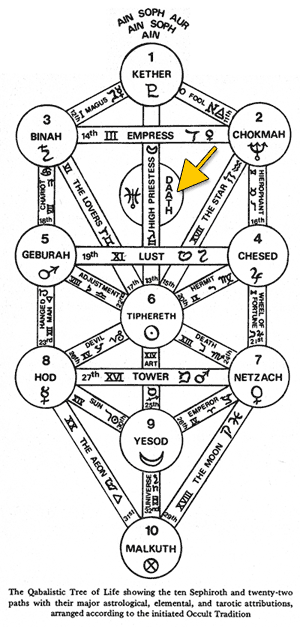
Tree of Life

January 1, 1997 by clerk

Lon Milo DuQuette is the author of Angels, Demons & Gods of the New Millenium and well-known student of the A. ·. A. ·., a school for magicians co-founded by Aleister Crowley.     His explanation of the Tree of Life is given here in the public interest to show how the Qabalastic Tree of Life is taught and understood in that discipline.

DuQuette, L. M. (1997). Angels, Demons & Gods of the New Millenium. York Beach: Samuel Weiser, Inc.

Filed Under: Glossary Tagged With: Glossary

Tunnels of Set

January 1, 1994 by clerk

Full magical initiation is not possible without an understanding of the so-called qliphotic paths which are, in practice, as real as the shadow of any object illumined by the sun. In other words, the well-lit highways of Horus, the paths that man has projected to connect the cosmic power-zones (Sephiroth) with his own consciousness, have their counter-parts in the Tunnels of Set, a dark web or nocturnal network of paths, the very existence of which is denied or ignored by those who are unable to realize the total truth of the Tree and its validity for those who would climb even its lower branches.

[…]

I am fully aware that the averse regions of the power-zones are dangerous territory, and at the outset I would remind those who feel that such an exploration had better not be made that one cannot begin this initiation, or journey inward, as one begins one’s ascent from Malkuth, for only by projecting consciousness through Daäth, the Gate of the Abyss, can one enter the Kingdom of infernal spaces that is under the dominion of the Choronzon. One has therefore to be familiar with these paths before one can enter the Deep Place where they continue, not as well-lit Ways of Horus plainly signposted in the light of day, but as the Tunnels of Set that turn and twist like a serpent, or like the entrails of that nameless God of the Gulf whose darkness makes possible, by contrast, their light counterparts.   If this is borne in mind it will not be necessary to charge me with irresponsibility towards those who may be lured, even against their will, to commence a journey for which they are improperly equipped and which may therefore prove fatal.

Grant, K. (1977). Nightside of Eden (1994 ed.). London: Skoob.

Filed Under: Glossary Tagged With: Glossary

Tree of Life

January 1, 1994 by clerk

The ten cosmic power-zones and the twenty-two paths constitute the Tree of Life. (See diagram.)

Grant, K. (1977). Nightside of Eden (1994 ed.). London: Skoob.


Filed Under: Glossary Tagged With: Glossary

Tree of Death

January 1, 1994 by clerk

Tree of Death: The averse Tree of Life with its tunnels of Set1 to which Daäth is the Gateway.

Daäth is the gateway to the ‘other’ world – Universe ‘B’ – sentinelled by the Beast 666 […] hence its association with death as the formula of transition form the phenomenal world of appearance to its source in noumenon; the absence of the apparent and the presence of the real.

Grant, K. (1977). Nightside of Eden (1994 ed.). London: Skoob.

Notes

  1. See Tunnels of Set ↩︎

Filed Under: Glossary Tagged With: Glossary

  • Page 1
  • Page 2
  • Page 3
  • Interim pages omitted …
  • Page 38
  • Go to Next Page »

Footer

Archives

Tags

black propaganda chaos merchant criminals David Miscavige dead agent enemy Ethics evil purposes Fair game FDA FPRD Gerry Armstrong Glossary GO Intelligence Course government HFPRDA How to Confront and Shatter Suppression PTS/SP Course HSSC illness intelligence Interrogation L. Ron Hubbard legal Mary Sue Hubbard NCG OSA overts overts and withholds personnel requirements PR psychiatrists psychiatry psychosis PTS Rehabilitation Project Force rock slammers roller coaster RPF Russia scapegoating Scientology security Sea Org security checks SP Doctrine Suppressive Person

Search this site

Copyright © 2026 · Infinity Pro on Genesis Framework · WordPress · Log in

imunify-bot-check